Showing posts with label Aotearoa. Show all posts

Tuesday, 17 September 2019

Kia ora whānau!

By Erika Vas, 2nd year MDP student

As mentioned in my last blog post, I cam completing my international field placement interning at The Lifewise Trust, focusing on areas of housing and homelessness, mental health and addiction, community and land development, and infrastructure. My placement has provided me with diverse opportunities to take my learnings from the office, to the streets, and to be welcomed by whānau into their communities. The time I’ve spent with whānau has been impactful, and has been a personal journey as much as an academic one for me.
In choosing my field placement, I wanted to pursue my passions, and continue to learn and grow in the field of housing and homelessness. Having focused my Major Research Project on on-reserve housing in Canada, and through my involvement with the Institute for Urban Studies (IUS) at the UW, my Supervisor, Dr. Jino Distasio was pivotal in supporting me to pursue my placement in Tamaki, and in connecting me with the Lifewise Trust. The IUS and Lifewise share a common thread of Housing First (HF), as Lifewise has modelled their program after that of Winnipeg’s and looks to Canada as a leader in HF, especially given Winnipeg’s Indigenous focus.
As mentioned by the Ministry of Housing and Urban Development, “HF was launched in Auckland with Government and Auckland Council funding in March 2017, and expanded to Christchurch, Tauranga and Hamilton in 2018”. HF is offered in multiple cities and areas in Aotearoa, including and Rotorua (where I completed my placement). HF is an international approach to solve social issues of housing and homelessness, recognizing that if we are to solve the issue of homelessness, we need to put people first. This approach supports individuals with multiple, high, and complex needs, knowing that when people are housed, they can be supported to address their complex needs.
During my placement, I had the chance to learn from HF whānau, Peer Support Leaders, Key Workers and Senior Practitioners in both Tamaki (Auckland) and Rotorua. I’m grateful to have been included in home visits, tenant lease agreements, home inspections, housing workshops & meetings, radio and tv interviews, and days spent shadowing these wonderful teams.
 It was very interesting for me to note the similarities and differences in HF delivery internationally (between Canada and Aotearoa) and also within Aotearoa. The strength of HF comes from its ability to be localized and adapted to meet the needs of the people. For example, in Canada, the city of Toronto implemented an Anti-racism/Anti-oppression intervention, whereas there was an Indigenous-focused, trauma-informed intervention. I was able to see the differences in localization of HF in Tamaki and Rotorua (which are considerably closer than Winnipeg and Toronto), and because of the history, community ties, geography, and the ways in which relationships were present in these cities, their deliveries were also diverse. Rotorua HF is a partnership between Lifewise, Te Taumata O Ngāti Whakaue Iho Ake Trust and LinkPeople, making it the first Iwi-led Housing First Collective in Aotearoa, grounded in a kaupapa Māori approach.
As I reach the end of my placement, I am looking forward to returning to Rotorua to return to friends, help with preparations for The Big Sleep Out, and participate in this great event. I’ve spent quality time with Housing First Rotorua and I’ve seen firsthand how they are changing lives - beyond meeting immediate needs, but letting whānau lead & giving them a chance to thrive. I can’t think of a better way to celebrate this time here than spending a night with whānau, coming together over kai and stories, and raising awareness and funds for this community, supporting them in their community-driven work.
Aroha nui.

Saturday, 14 September 2019

It’s all relational

By Chelsie Parayko, 2nd year MDP student
As my time in Aotearoa came to an end, I reflected on the experiences I’ve had over the two field placements that we are required to complete. Some of the most valuable lessons and knowledge came from those experiences, however the relationships I have formed are ones that will last beyond the walls of academia. Below is the post:
Last summer I learned a Cree word – Kiwícéwákan, it roughly translates to “the one you walk with.” Beyond the simple English translation, in Cree this word means more than to simply walk but to journey, to connect, to have meaningful relations with another person or persons. I learned this word while completing my domestic field placement for my master’s in Development Practice: Indigenous Development program, from a beautiful Cree woman who seemingly understood what was happening in my life before I knew it myself. The word rings true in certain spaces I have occupied and is something that has been dancing through my mind in recent.
As a child I wanted to sink into the masses. At the time, this meant lathering my body with sunscreen and restricting the hours I spent outside in the sun to avoid being “too brown.” I was terrified of having the conversation around who my ancestors are, and what that meant among my peers. I knew that, at that time, being identified as Indigenous or as Cree that I would be treated differently, perhaps treated like a second-class citizen. It has taken a lot of uncomfortable moments to shift my own perspective and my journey of unlearning is only at the beginning. Surrounding myself with other Indigenous peoples who celebrate their ways of knowing is critical to my own wellbeing and is why I was attracted to Aotearoa.
These pivotal moments are one of the most spirit awakening, however they are often the path-less-taken, and rather lonely within western academic walls. Carved by our strongest ancestors, these journeys today are what I believe to be my greatest responsibility. There are movements that have been radical in shaping the atmosphere that Indigenous peoples in Canada, however from a smaller scale we more often see individuals taking the lead in resurging our ways of knowing and being, unsupported. My own experiences have held true to this fact.
It has been one of the most refreshing and awe-inspiring things to be among the whānau at Waipareira who, for lack of better words, just get it. Making space for Indigenous ways of knowing and being is embedded in the everyday practices and is certainly something that I will take home as one of the most profoundly key elements of success for the iwi.
Reflecting on my experience in Aotearoa, within the MDP program and beyond I cannot help but be incredibly proud at the people I have met along the way and for those who have launched down this journey with me. People like my sister who have, unapologetically taken on roles not traditionally held by women to ensure that our traditions are not lost. Teams like those at Waipareira who make space for Indigenous ways of knowing regardless of the dominant western systems and structures. I am so grateful to call these people my whānau. There are not enough words to begin to extend the gratitude I have for this opportunity. Ekosani for being Kiwícéwákan!” 
Connections and relationships are everything. As an Indigenous person it has been taught to me that everything is relational, and through these two placements the lesson has been incredibly solidified. These relationships span across oceans and land, to the animals and the plants, to the stars and back. So much to be thankful for.
(L-R) Sneha Lakhotia, Cate Mentink, Chelsie Parayko, Tanya Allport and Haze White

[1] Parayko, C. (2019). Ekosani for being kiwicéwákan. Retrieved from https://www.waipareira.com/wai-atamai/

Saturday, 7 September 2019

A placement that made me feel like I belonged

By Henok Alemneh, 1st year MDP student

As part of the World Indigenous Tourism Alliance (WINTA) broader advocacy strategy to promote research and development projects that emphasize the rights of Indigenous peoples in tourism, one of my roles involved planning and organizing a seminar on ‘Tourism Industry Engagement with Indigenous Peoples as Rights-Holders’. 

The seminar aimed at raising the profile of WINTA and its Indigenous Tourism Engagement Framework (ITEF) to a diverse audience that was comprised of people from academia, tourism bodies, NGOs and government. The project was realised through collaboration among WINTA, Victoria University of Wellington and Kapiti Island Nature Tours. Victoria University collaborated by hosting me as a visiting master’s scholar and by integrating our seminar into the University’s School of Management Seminar Series. Dr. Christian Schott, a Senior Lecturer at the University, contributed by coordinating these and serving as a chair for the seminar. Mr. John Barrett, who is the Managing Director and Founder of Kapiti Island Nature Tours, collaborated by presenting on the seminar and sharing practical information on an earlier WINTA facilitated project that involved his community.   
Part of the organizing team:
L-R: Dr. Christian Schott, Henok & Johnny Edmonds
My work on the project started by putting together a project outline following initial meeting we had with the organizing team and continued through regular consultation with my supervisor Johnny Edmonds, Director, WINTA. Being given the responsibility to coordinate the seminar taught me how to perform such tasks independently and at the same time make effective use of the team environment and support system available. The knowledge and experience I obtained from my studies and lessons I learned from our previous Kapiti Island project was very helpful in planning and organizing the seminar.

The planning activities for the seminar involved designing the presentations in a way that respects and integrates Maori/Indigenous protocols, methodologies and literature. The presentations were also designed to encourage active engagement of seminar participants through sharing of practical information, a handout provided with key information, use of relevant pictures and diagrams, posters, and through a discussion and Q&A session. Arranging venue & date, writing the seminar abstract, project report & evaluation, organizing promotion, invitation & webinar delivery options, preparing forms, slides, notes & other documents, and presenting on the seminar are also among the activities that provided me with tremendous learning, networking and professional development opportunities. Through these experiences, I was able to improve my research and project management skills and learned how things happen in the real world of development work.
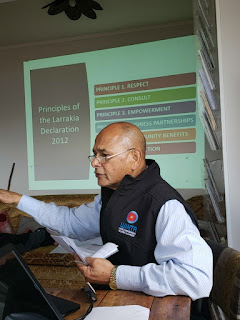
Henok presenting on WINTA's ITEF
One of the major tasks during the planning phase of the project was building on WINTA’s concept of ITEF, a roadmap being developed to enhance respectful engagements between Indigenous communities and all other key players in Indigenous tourism based on the Larrakia principles of respect, consultation, empowerment, partnership, community benefit and protection. A diagram was designed to illustrate the key foundational components of the engagement framework and a paper describing the concepts was written with the information being made available for potential use and improvements.   This task required a review of literature and identifying issues and gaps as it relates to rights-based Indigenous tourism. I also did a review of WINTA’s documents that are of relevance to the particular focus of the seminar. These tasks taught me different set of skills for engagement in research activities.
Seminar participants
Overall, the projects I have been engaged in are vital in providing roadmaps and strengthening the foundational work which will be built on through subsequent projects in various parts of the world through WINTA’s team and global network. One of the initial steps we have taken for the purpose of a wider promotion and feedback on WINTA’s rights-based approach to tourism was to create a webinar video of the seminar presentation. This is expected to be shared through WINTA’s global network. I obtained great experiences from the planning and implementation of this seminar project. Moreover, the core values of the organization and the responsibilities I was entrusted with made me feel I belonged. I am very grateful for the incredible support of WINTA and its director, University of Winnipeg, Queen Elizabeth II Diamond Jubilee Scholarship, Victoria University of Wellington and all individuals and organizations that I haven’t mentioned by name.

Tuesday, 20 August 2019

Enriching placement experience in Aoteareo, Land of the Long White Cloud

By Henok Alemneh, 1st year MDP student

For my international placement, I reached out to and arranged to work with World Indigenous Tourism Alliance (WINTA), under the direct supervision of Johnny Edmonds, the Director of WINTA.  This 3-month placement based in Wellington, Aotearoa, New Zealand allowed me  an incredible opportunity to learn both about the Maori people, their culture, and WINTA. WINTA has a mandate to engage in Indigenous tourism advocacy, facilitation and networking activities as recognised by the World Tourism Organization (UNWTO) in its endorsement of the 2012 Larrakia Declaration.  I was tasked to work on three major projects: Facilitating Kapiti Island Community Workshop, organizing a Seminar on WINTA’s rights-based Indigenous Tourism Engagement Framework (ITEF) & Reviewing WINTA’s Training Collateral.
Henok and Johnny Edmonds at work workshop planning
The Kapiti Island whanau (family) workshop was titled: The practices we want tour/travel operators to follow when engaging with us.  The workshop aimed at creating a platform that could enable the whanau to collectively share and discuss their expectations of the practices tour and travel operators need to follow when engaging with them. In preparing for the workshop one thing stood out to me was the process of framing and positioning the workshop in a way that affirms the communities’ engagement right from the outset. As my supervisor says “we are not selling something to them. It is the communities’ workshop. WINTA’s role is to facilitate.” We aimed to make sure all activities, presentations and forms align with what the whanau was looking for and we provided progress updates. I found the whole process an exemplary approach by an international organization who considers its obligation to allow the community to guide all elements of the project.
Kapiti Island is about 5km off the west coast of the southern part of the North Island of New Zealand. Part of this Island is a government natural reserve and “of the total 1965 hectares, the local tangata whenua (Maori people of the land) together kept 13 hectares around Waiorua Bay, and this is where the Lodge is today” (https://www.kapitiisland.com). Our team was privileged to visit the island and the lodge. In order to minimise the risk of insects like Argentine ants and pests spreading to Kapiti island, the whanau does biosecurity checks before boarding the boat to the island. Everyone, including whanau members, are required to clean footwear to remove soil, seeds and diseases.  This is an exemplary practice of communities safeguarding the land.  All are required to respect the protocols, including what to bring and not to bring to the Island.
Henok on Kapiti Island
Being part of this project I learned some Maori cultural protocols, including Mihi Whakatau. A mihi whakatau, according to my host supervisor, is a speech of welcome performed by the Kaumātua or kaiārahi to the visiting group and is sometimes followed by a waiata (song). It can be responded to from someone in the visiting group in the appropriate manner, but does not necessarily need to be responded to. Before we entered the lodge, the whanau performed the mihi whakatau followed by waiata . As we  faced each other (visitors on one side and the whanau on opposite), a beautiful Maori song was sung. Another person and I responded from the visitors’ side. I responded in my first language (Afaan Oromoo), starting with a greeting, then acknowledged the Mana Whenua (people of the land), the E Nga Mate (Ancestors) and the Papatuanuku (mother earth) and finally I expressed my gratitude for being there. I wore my own cultural dress and shared a little bit of my culture. I also sang a waiata, that I practiced beforehand, with the rest of our visitor group. 
On completion of our whaikōrero (speech) and waiata, we went around and did the Hongi / Harirū. It is the act of pressing noses, sniffing and shaking hands. My supervisor taught me that it brings both visitor and host together as one. It is so powerful in making one feel welcome. What I felt after that was really like being with family, and among people who love you and care for you. It gave me closeness and openness with many of them afterwards. I think the whole welcoming process created a relationship among all of us that made the workshop very engaging. For me personally, it also connected me to the Maori culture and tradition.

Henok facilitating Kapiti Island Whanau Workshop
The workshop project was very important not only because of its potential value for the whanau, but also because WINTA wishes to create opportunities to further improve future delivery to other Indigenous communities and tourism businesses. Analysis and interpretation of participants’ feedback was undertaken from evaluation forms and through the traditional poroporoaki protocol where anyone can speak at the end of the workshop. It is the communities’ way of stating how the gathering went. The evaluation process helped knowing what we could have done better, both for the whanau and WINTA’s benefit. 
Johnny Edmonds
I believe the workshop indeed provided WINTA an opportunity to test the engagement framework it has been developing and inform improvements for future facilitation of such projects with other Indigenous communities involved in tourism activities. Such projects are also essential steps towards enhancement of rights-based Indigenous tourism engagement. Every task in this project taught me a lot about community workshop planning, facilitation, project evaluation and report writing, and also skills and ways of doing these along with the community and under the guidance of their culture. I clearly understood how important it is to build respectful relationships when engaging in community projects. We couldn’t have achieved positive outcomes through this project, both for the Kapiti whanau and for WINTA, without the connections we built and strengthened through the Indigenous values of kinship, reciprocity, respect, partnership and sharing. Through these values, we acknowledged that we are all related, that we are part of everything around us, that we are interdependent, that we respectfully do our homework before we engage with other parties, that we engage in a mutually beneficial partnership, and that we share information and understanding rather than telling them what to do. 
These lessons have been carried on for the other major seminar project I took part in and I invite you to read my second blog titled ‘A placement that made me feel like I belonged’.   

Saturday, 17 August 2019

Music to my ears

By Chelsie Parayko, 2nd year MDP student
My community has completely lost our language. Colonization has stripped that ability away from my people. In 2018 my people came together and celebrated finally receiving reserve designation on the lands we had been gathering on for time immemorial. We invited our sister nations and leaders from across Turtle Island, including Grand Chief Jonathan Solomon.  Jonathan took the time to congratulate us and said,
 I am not usually an emotional man but being here on the land with you is making me cry. I had a dream last night that your language returned to these lands. That your people once again spoke those words.”
His words rang in my ear and in my heart.
In Aotearoa, Waipareira welcomed me into their whānau with a whakatau, a traditional ceremony to welcome new people into their family in a good way. The first thing I noticed was how vibrant their language and songs were. The staff spoke mostly in te reo Māori and everyone sang their beautiful songs with ease. It was the most beautiful thing.
Nearing the end of my time in Aotearoa this trip I was talking to a friend about my community and our loss of language. She told me that her peoples retained a lot of their language through song and perhaps that is how we will learn again. So there lies my newest great adventure, to learn our songs so that my territory can hear those words be spoken again.
Chelsie at Monkey Creek

Thursday, 1 August 2019

My placement with LIFEWISE, Aotearoa

By Erika Vas, 2nd year MDP student

From June to September 2019, I am fortunate to be completing my international field placement with the Lifewise Trust in Tamaki, Aotearoa. The Lifewise Trust (LIFEWISE), Airedale Property Trust (APT), and Methodist Mission Northern (MMN) operate interpedently in order to work towards the vision of connected, just, and inclusive communities. Each Trust is dedicated to family and community resilience, from working with people and families directly, to providing financing and infrastructure which makes this work possible.
In choosing my international placement, I wanted to continue to learn and grow in the fields of housing and homelessness, community and land development, and infrastructure. Based out of the University of Otago building, Airedale Property Trust, Methodist Mission Trust (Splice), and Lifewise share one main office. This office is a busy, but united hub of activity, from property management, community building, youth homelessness initiatives, fundraising, research, development and practice and much more. I am working among many individuals who are committed to making homelessness rare, brief, and non-reoccurring and are keen on sharing their work and experience with me.
I have been welcomed into the Lifewise Practice & Development Team and have focused on Housing First (HF) projects. I have analyzed and interpreted documents to create briefing documents for government officials, I am currently working on collecting, analyzing, and interpreting data gathered by the HF program in Auckland, with the goal of reporting how the program might be improved or developed, informing community service providers on the wants and needs of whānau, and reporting on the realities of the health and wellness of whānau to external stakeholders, I have completed research on IPS Supported Employment (Individual Placement Support), and documenting the Kaupapa Māori / iwi-led model that is being used for the delivery of HF in Rotorua. While simultaneously working on these projects, I’ve been a part of the Tamaki community, going on home visits with the HF Team, attending community events such as the Piki Toi Artist Exhibition, standing in solidarity with whānau to protect Ihumatao , celebrating the opening of the Pitt Street residence (a HF home, but also an artists’ collective), attending symposiums related to Marae housing and HF, and participating in The Big Sleep Out in Rotorua, for one night, coming together with community and business leaders and to experience what it’s like sleeping rough, getting a taste of life on the streets, and raising critical funds to prevent homelessness.
I would like to say a BIG Tēnā Koutou to all my whānau Aotearoa. Learning about Maori culture, sharing stories, and experiencing the beauty of the people, language, and land has been a life-changing journey that I’m grateful to have shared with all of you.
Ka kite anō au i a koutou.

Friday, 1 September 2017

Rautaki Māori

By Paige Sillaby, 2nd year MDP student 
 
Paige in front of the Te Whānau o Waipareira office

It’s been a month since I completed my international field placement at Te Whānau o Waipareira, and I am missing my Waipareira whānau, as well as the breath-taking mountains of Aotearoa New Zealand. Words cannot describe how deeply this summer’s field placement has impacted my personal and professional development. 

During the first month of field placement, I spent a lot of my time reading through documents to help me understand Waipareiratanga, which loosely translates as the unique way in that Waipareira operates as Māori organization. Some of the documents that I reviewed were; Te Whānau o Waipareira Strategic Plan, and the Waitangi Tribunal.  I would say that much of the information I learned this summer came from speaking with members of the Strategic Innovation team, as well as Wai- Research team about Maori culture, and the history of Aotearoa.

Mount Eden
My primary research project at Waipareira was to work alongside key staff to research and document the Rautaki Māori – Work-Placed Language Revitalization Strategy pilot. The culmination of this research is a summary report with a toolkit that can be used to implement language revitalization strategies in other Indigenous organizations. The overall purpose of the Rautaki report was to gather feedback from key participants in the Rautaki Māori model and designed to meet the following three objectives.

          To determine and understand the impacts of Rautaki Māori on Wai-Atamai and Wai-Intel,

          To identify strengths, challenges, and opportunities of the Rautaki language strategy

          To document Waipareira Rautaki Māori model as a strategy for workplace language revitalization.

At the end of my placement, Waipareira generously printed out the Rautaki Māori report, which was put together by the Graphic Design team. I was not expecting Waipareira to do this, and I am so appreciative that they provided me with copies to take home and share with Indigenous organizations elsewhere.

Through my time in Aotearoa and especially working on Waipareira language revitalization strategy, I have truly been inspired to learn my Indigenous language. During my three months at Waipareira, I learned a little bit of Te Reo through the Rautaki Māori initiative. One of the Rautaki activities was to build a pepeha. The pepeha is a way of positioning yourself within a Māori worldview.  I am proud to share my pepeha;

Ko Horseshoe te maunga
Ko Simcoe te roto nui ake
Ko te Alantic te moana
Ko Big Canoe te rangatira
Ko Georgina Community Centre te wharenui
Ko Chippewa ki Georgina Island te hapū
Ko Ojibway te iwi
Ko Paige ahau

I would like to say chi-miigwetch/ thank you to Waipareira for hosting my field placement. Also, I recommend checking out #WaiRauMaori on twitter to see some of the awesome Rautaki Māori activities from with summer!

Ngāpuhi