Showing posts with label food security. Show all posts

Tuesday, 5 July 2022

Wahkomiwew - Being connected to the People

By Christy Bird


Christy and Kaitlyn Murdock 

Boozhoo, Tansi. Christy Bird ndizhnikaaz Peguis/Fisher River indoonji. I am near completion of my time in MDP, and it has been a great learning experience. For my final field placement, I am working under the supervision of Dr. Shailesh Shukla with Fisher River Cree Nation (FRCN) developing a traditional food guide that is reflective of their community. 

My Mom is Cree from Fisher River, and I spent a lot of time with family in Fisher River, so I am very grateful for this opportunity to connect with family and friends and build new relationships with youth in the community. 

As a part of my placement, I have met with several community members that work in the community and have participated in a community event organized by Sharon Monkman from Fisher River Health seeking their inputs in designing traditional food guide project through a written survey. Community members provided useful feedback on potential content of the Fisher River food guide including important and healthy traditional Fisher River food items that should be included in the guide. 

I have also had the opportunity to visit Fisher River High School Land-Based educator Kaitlyn Murdock in their land-based program. In addition, I had the privilege to host two focus groups with youth that attend the program. There are still more interviews with knowledge keepers, youth and elders in the community that need to be completed, but it has been great to put learn and apply community-based research for this important project. 

Our key focus would be to engage local youth and knowledge keepers and build in their voices into their own food guide. We would also like to organize traditional recipe events open to FRCN community members sometime in early August. At the end of the event, we plan to host a community feast to present the traditional food guide to the community. 

Finally, it has been great to be in community, around people, especially after 2 years of virtual learning. Although virtual meetings occur weekly, in person dialogue and community visits are something that I enjoy the most. Miigwech.

Wednesday, 29 June 2022

Connect with Community Through Food

By Jessica Boucher-Cowie 

Hello! My name is Jessica and I am a first-year MDP student! For my Canadian field placement, I am working with NorWest Co-op Community Food Centre located here in Winnipeg. At NorWest Food Centre, many programs are based on offering accessible, low-cost, healthy foods to individuals and families.

NorWest has a variety of programs that assist in mitigating the impacts of food insecurity, through culturally relevant meals, food basket deliveries, and weekly fresh produce markets. NorWest has played a significant role in supporting community health and recently launched a community farm project, which will not only provide locally grown produce but also create a safe, green space for the community to gather.

My role over the summer is primarily focused on assisting in program delivery and the beginning stages of the community farm project. The community farm will offer workshops and activities related to traditional foods, planting, and preserving practices, which I will assist in coordinating. I have gained some insight into the daily operations of NorWest, and through engaging with their staff and volunteers, it is clear how much good can be achieved when people come together to reach a shared goal.

NorWest distributes hundreds of meals to people each week and has an ‘assembly line’ of volunteers to prepare and package meals. I participated in preparing/distributing the meal for their quarterly feast, which provided meals to more than 400 community members on a ‘take-out’ basis.

Regarding the community farm, we started by removing sod and evening the soil so that vegetables can be planted. We made three plots in total, two of which will be used for vegetables requested by the community, and seeds that were donated to NorWest. The third plot is designed in the shape of a spiral and traditional crops will be planted there with the guidance of an Elder.

 We have officially begun planting and are excited for what the upcoming summer months bring us, to watch the crops grow, and further connect with the community!


Wednesday, 11 August 2021

Costs, Benefits and Growing Plants in Water

By Andrea Dsouza, 1st year MDP student


Hello, my name is Andrea Dsouza. I was born and raised in Bangalore, India. In 2020 I completed an undergraduate degree in Indigenous Studies from the University of British Columbia. My field placement this summer was with Canadian Feed the Children (CFTC).


CFTC is a Canadian charity that works worldwide to ensure that children thrive free from poverty and hunger. In Canada, Bolivia, Ethiopia, and Ghana, CFTC partners with communities to strengthen their capacity to achieve long-term and sustainable change. This is done by supporting innovative food security endeavours, educational campaigns and monitoring and evaluation. What drew me to working with CFTC is that they integrate intersectional analysis into their work.


My task this summer was to conduct a cost-benefit analysis of indoor-growing units for CFTC’s partners in Canada. Many of these Indigenous communities are in rural and remote areas of Canada’s north, where the lack of access to sufficient affordable, nutritious food continues to be a critical issue. One possible way of meeting this need is by building hydroponic units in shipping containers. This method of growing does not require any soil, just water to grow a wide variety of leafy greens in communities. It is highly efficient as it uses less time, space, and crop inputs than traditional farming. It allows for year-round growing as all the elements involved in growing are monitored and controlled for optimal outputs.


I doubt that my placement would have looked different than it did if it wasn’t a pandemic. I enjoyed the fact that the work I was doing allowed me to work from anywhere! This meant I could head back to Vancouver for the summer and spend some with friends and family. I saw this work as an extension of my first year of university that took place entirely online. Therefore, doing this placement during a pandemic was not too challenging for me. I practised the communication and time management skills that I built during the year during this placement, which made it a success!


Thursday, 13 August 2015

Winding down Researching Resilience

By Dev Kashyap, 2nd year MDP student

With just a couple weeks left in my University of Winnipeg field placement in south-east India, I can't believe how time has flown by. However, in reflection, the past month has been a whirlwind of visits to 'Adivasi' or Indigenous communities in and around our base of Kotturu, in the state of Andhra Pradesh. Myself, along with my MDP classmate Manna Sainju and host organization Appropriate Reconstruction Technology Information Centre (ARTIC), have reached our goal of completing all key informant interviews and focus group discussions with our selected participating Adivasi communities in the month of July.

July took us through the beautiful landscapes of three local rural counties or "Mandals" as they are called in Andhra Pradesh; some of them accessible only by rugged roads. Part of what we have learned revolves around the similarities in Adivasi habitations in terms of the effects on them from changes over the past 30 years: globalization; emerging technologies and government programming and policies. What is certain is that all of these communities embody resilience in terms of their day-to-day living. Things that we take for granted in North America - such as constant electricity, piped water directed to our homes and easy access to irrigation - are amenities that require planning and hard physical labour in many cases here in rural India.

All in all, I am grateful for my experience here, the assistance I have had in my research from the team at ARTIC, and last but not least the willingness of the research participants to contribute to my higher learning about the rural experience of Adivasis in south Asia. Resilience is manifest in their processes of living day-to-day here and embodied in the daily tasks performed by Adivasi communities. Resilient communities carrying on in the face of externally-driven changes.

Dev, Prakash, Yamuna and Shrimaiji from ARTIC, and the research participants from the community of Bommika, Andhra Pradesh

Wednesday, 12 August 2015

Seeds and Stories in Araku Valley, India

By Kaitlyn Duthie-Kannikkatt, 2nd year MDP student

India’s food system has undergone many changes in the past few decades. Technologies have changed, staple foods have shifted, and food security has been variable. The situation for many tribal peoples is particularly acute as the varieties they’ve grown and the agricultural methods they’ve used for many generations become threatened by shifting economic, political, and cultural landscapes. 

But here I the state of Andhra Pradesh, in a hilly area called Araku Valley, the inevitability of that shift is being called into question. Tribal peoples are organizing to maintain the rich seed diversity that has characterized their lifestyle for generations. With the help of Sanjeevini, a community-based organization with which I’m undertaking my summer placement, people are becoming empowered to celebrate and cherish their seeds and the cultural lifeways that sustain them. 

Women carry a tuber harvest in from the fields

My role here is to develop a case study of Sanjeevini’s approach to mobilizing community-based seed conservation by interviewing farmers, network partners, government officials, and key staff and volunteer members about the impact of Sanjeevini and the sustainability of their approach. Most of my time thus far has been spent living in a rural village, nestled in a gorgeous agricultural valley, talking to farmers every day about the kinds of varieties they’re growing, the preservation methods they use, and their commitment to passing their knowledge on to their children and grandchildren. 

Understanding the role that Sanjeevini has played in supporting people in that work is inspiring. They take a holistic approach that is uncommon in the NGO world. They recognize that people cannot keep that agrobiodiversity alive without just access to land, livelihood opportunities, access to education, and the fulfillment of basic human rights. Their work is rooted in strong relationships with local people who know they can trust Sanjeevini to organize on their behalf when one of those factors is at risk. 

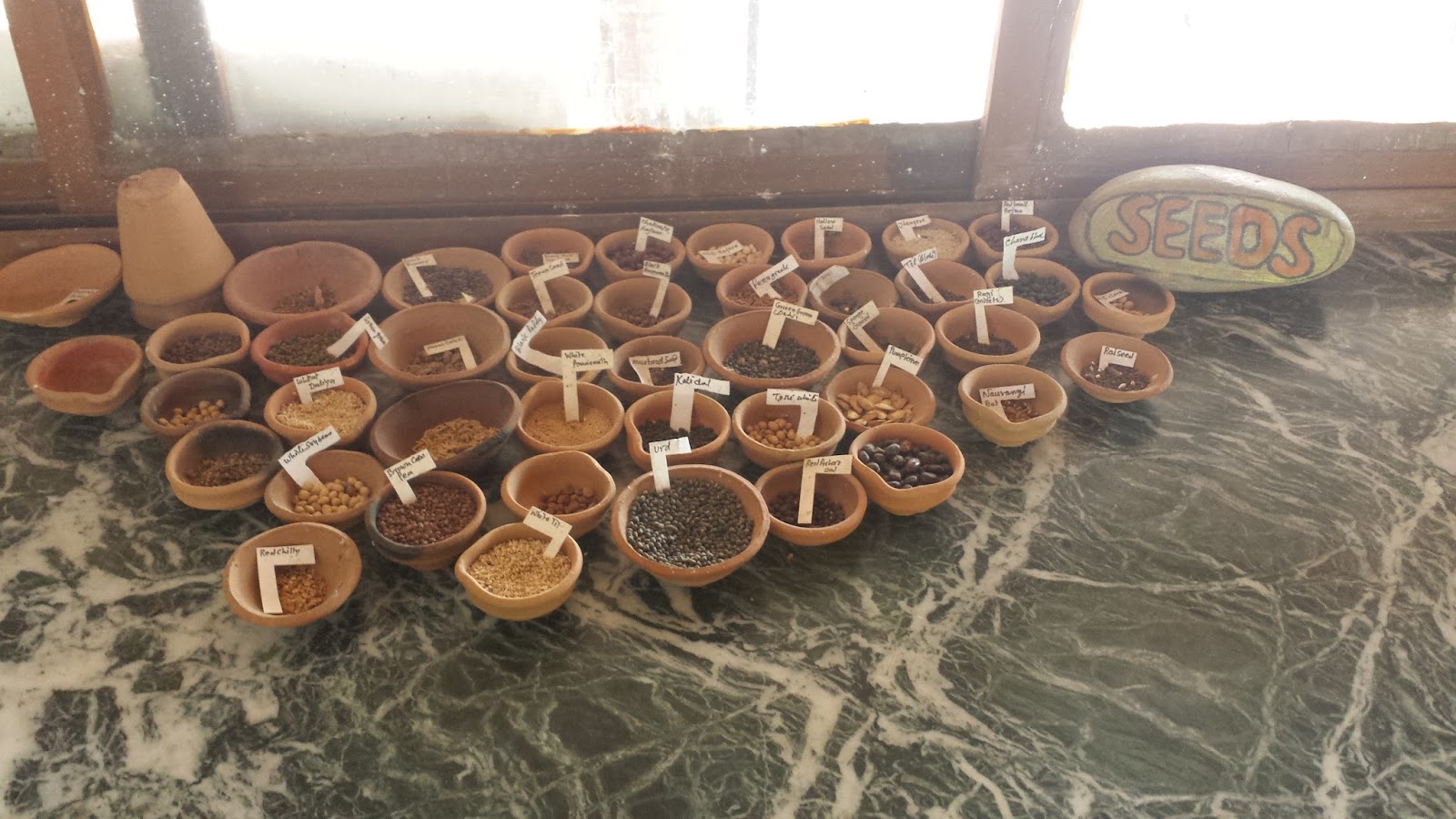
Selections from Sanjeevini's extensive seed bank

The founder and general secretary of Sanjeevini, Devullu, told me this: “In the beginning, they (government and others) thought I was a mad man. ‘Why would you want to preserve old seeds when there are hybrids, new technologies that tribal people should embrace?’ they would cry. Now, two decades later, everyone knows how important this work is – government, NGOs, universities, and all are keen to work with Sanjeevini to support tribal farmers.”

Learning Dhimsa (traditional dance) with my aunties
Agrobiodiversity is increasingly on the radar of actors at the state, national, and international levels. Sanjeevini, however, has always known that supporting local, traditional knowledge is the key to sustaining that diversity. Indigenous people have to be supported if that diversity they have stewarded for so long is to be maintained. It’s encouraging to see that notion is catching, however long it’s taken to get there.